
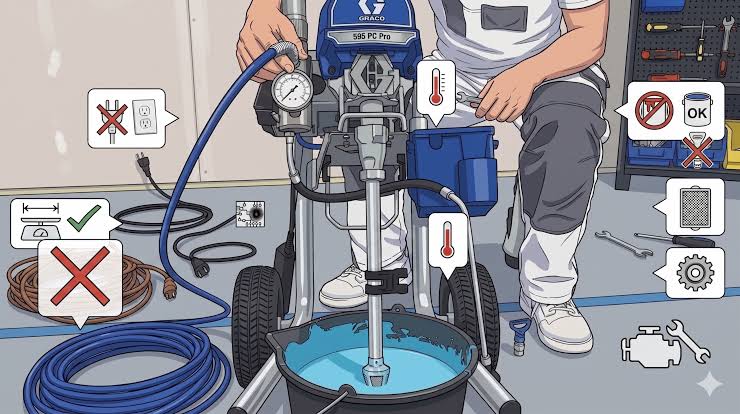
Nothing stalls a painting job faster than standing in front of a sprayer that’s clearly not performing right, with no idea which of a dozen possible components is actually the problem. Most people’s instinct is to assume the worst — a failing pump, an expensive repair — when the real fix is usually a cheap, five-minute swap. Knowing how to diagnose before you shop for graco sprayer parts saves both money and the frustration of ordering the wrong thing twice.
Start With the Cheapest, Most Common Culprit: Filters
Before assuming anything more serious is wrong, check the gun filter and inlet strainer. Clogged filters are, by a wide margin, the most common cause of sudden pressure drops, uneven spray patterns, and intermittent spitting — and they’re also the fastest and cheapest thing to rule out. A two-minute filter swap resolves a surprising share of what looks, at first glance, like a major pump failure.
Reading Symptoms Correctly Before You Order
- Won’t prime after storage → check the inlet valve and ball before assuming a pump failure
- Sudden pressure drop mid-job → check filters first; a kinked hose is the second most likely cause
- Uneven or tailing spray pattern → tip wear, not a pump issue, in the large majority of cases
- Fluid leaking near the gun handle → seals or O-rings inside the gun, unrelated to the pump
Misdiagnosis is the single most common reason people end up buying the wrong part, then having to reorder once the actual issue becomes clear. Working through this list before placing an order saves a return-and-reorder cycle that can cost several days on an active job.
The Parts That Wear Fastest, Across Every Model
Regardless of which Graco sprayer you own, the wear pattern tends to follow the same order. Filters and strainers clog first from ordinary use — cheap, expected, and quick to fix. Spray tips wear wider over time and start producing tails or an uneven fan; this is a consumable, not a defect, and every sprayer eventually needs a fresh one. The component that causes the most confusion is the prime valve — a machine that primed fine last season but suddenly won’t hold after winter storage is almost always a prime valve issue, not a sign the pump itself is failing.
Genuine Parts vs. Generic: Why the Cheaper Option Often Costs More
It’s tempting to grab a generic “universal” filter or tip from a big-box shelf, especially when it’s cheaper and available same-day. In practice, airless pump tolerances are tighter than they look, and a slightly-off generic part tends to cause more problems than it solves — inconsistent priming, premature wear on the seals around it, and a spray pattern that never quite looks right no matter how carefully the pressure is dialed in. Genuine, model-matched parts cost a little more upfront and consistently save money over the life of the machine.
Building a Basic Stock Before You Need It
The owners who lose the least time to sprayer problems share one habit: they buy wear parts before something fails, not after. A spare tip, a couple of gun filters, and a prime valve kit cost very little relative to a lost weekend waiting on shipping mid-project.
- A spare tip matched to your most-used coating type
- 2–3 spare gun filters and an inlet strainer
- A prime valve kit, especially before seasonal storage
- Pump Armor storage fluid, always on hand before it’s needed
Matching Parts to Your Specific Model
One detail that trips up even experienced owners: the series letter on a machine’s serial tag, appearing directly after the model number, often determines whether a part actually fits. Two machines with the same model number but different series letters can have different pump compatibility. Checking that tag before ordering — rather than assuming based on model number alone — prevents the most common return-and-reorder cycle, and if there’s ever doubt, the full range of graco parts organized by model makes it straightforward to confirm the right match before you buy.
The Bottom Line
A sprayer that seems broken is, in the large majority of cases, a sprayer that needs a cheap, predictable wear part — not a machine on its way out. Diagnosing correctly the first time, buying genuine and model-matched, and stocking ahead of the season are what keep parts spending proportional to what actually needs fixing.
Frequently Asked Questions
Should I always check the filter first when something seems wrong?
Yes — it’s the fastest, cheapest thing to rule out, and it resolves a large share of issues that initially look more serious.
How do I know which series my machine is?
Check the serial tag on the machine body; the series letter typically appears directly after the model number.
Is it risky to install a part that’s close but not an exact match?
Yes — a near-fit part can cause leaks, pressure inconsistency, or accelerated wear on surrounding components.
How often should wear parts be replaced on average?
There’s no universal interval — it depends on usage frequency and maintenance habits. Tracking your own machine’s wear pattern over a season is more reliable than a generic schedule.