
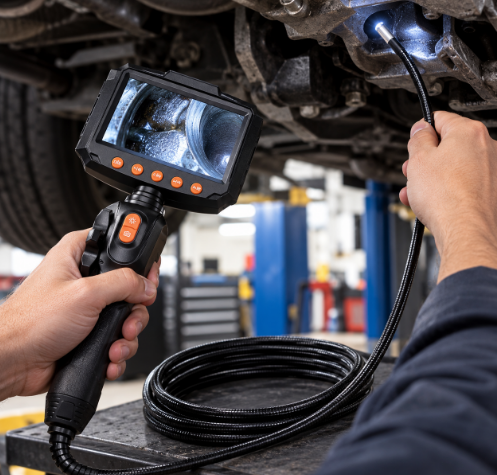
A mechanic hears an unusual engine noise and needs to determine whether the problem is inside a cylinder. Removing the cylinder head would expose the area, but it also turns a diagnostic check into a much larger repair job. A borescope can provide another route: insert a small camera through an existing access point and inspect the internal components without major disassembly.
This is where automotive borescopes become useful. They can help inspect areas that are difficult or impossible to see directly, from combustion chambers and cylinders to transmission components, exhaust systems, and other confined spaces. The important part is choosing a scope that matches the vehicle and the specific inspection. Probe diameter, articulation, camera quality, lighting, viewing angle, and reach can all affect what you can actually diagnose.
Start With the Automotive Problem You Need to Investigate
A borescope should be selected around the inspection task rather than treated as a general-purpose camera.
For example, checking a cylinder through a spark plug opening has different requirements from inspecting a transmission housing or following a narrow passage through an exhaust system.
Before choosing a scope, identify:
- Where the camera needs to enter
- How far it needs to travel
- Whether the path contains bends or obstacles
- What component needs to be viewed
- What type of defect you are looking for
- Whether you need still images or video for documentation
This prevents a common mistake: buying a scope with impressive specifications that cannot physically reach or properly view the problem area.
Inspect Engine Cylinders Without Major Disassembly
One of the most practical automotive uses for a borescope is inspecting the inside of an engine cylinder.
After removing a spark plug, the camera can be guided into the cylinder to examine the piston crown and cylinder walls. The inspection can provide visual information before deciding whether deeper disassembly is justified.
What to Look For Inside the Cylinder
The goal is not simply to confirm that the camera reaches the cylinder. Position it deliberately and inspect the areas that can reveal abnormal wear or damage.
Look for:
- Scoring or unusual marks on cylinder walls
- Piston crown damage
- Abnormal deposits
- Signs of oil contamination
- Evidence of overheating
- Foreign objects or debris
- Visible cracks or damaged surfaces
Move the camera slowly rather than relying on a single view. Rotate or articulate the probe when possible so the cylinder wall can be examined from different positions.
A useful inspection record should also distinguish between normal surface characteristics and findings that actually warrant further testing.
Use Articulation When Straight-Line Viewing Is Not Enough
Getting the camera inside the engine is only the first challenge. The next is getting the lens pointed at the right surface.
A fixed probe can work when the target is directly ahead. However, automotive components often leave very little room for repositioning the camera once it is inside.
An articulating car inspection borescope can provide additional control over the viewing direction. This is useful when inspecting internal components or when the suspected problem is located on a sidewall rather than directly in front of the lens.
For automotive work, probe diameter matters here too. A probe needs to be thin enough to enter the available opening while still providing the articulation and imaging capabilities required for the inspection.
Check More Than the Engine
Automotive borescope inspections are not limited to cylinders.
The same basic approach can be useful for other difficult-to-access areas, provided the probe can safely enter the space.
Transmission and Gearbox Inspection
Internal inspection can help locate visible signs of wear, damaged components, debris, or contamination without immediately opening the entire assembly.
The camera needs enough maneuverability to inspect surfaces that are not directly in front of the access point.
Exhaust System Inspection
A borescope can help examine sections of an exhaust system for obstructions, damage, deposits, or deterioration.
Here, probe length and diameter become particularly important because the inspection path can be long and narrow.
Other Confined Automotive Areas
Depending on the vehicle and access available, a scope may also help inspect:
- Intake passages
- Valve areas
- Turbocharger components
- Radiator and cooling-system areas
- Door and body cavities
- Wiring and difficult-to-reach mechanical spaces
The specific inspection method should always account for the component’s temperature, fluids, moving parts, and other conditions before inserting the probe.
Pay Attention to Camera Diameter
A vehicle can have extremely limited access points. A probe that works perfectly for one inspection may be unusable for another.
For engine work, the available opening can dictate the maximum probe diameter. A thinner probe is easier to insert through narrow openings, but you should still check whether its camera, lighting, and articulation provide enough capability for the job.
Do not choose diameter based solely on the camera head fitting through the opening. The probe also needs enough flexibility to reach the target without becoming difficult to control.
Measure the access point first, then compare that measurement against the complete probe dimensions specified by the manufacturer.
Get Enough Light Inside the Component
Automotive components are often enclosed, reflective, oily, or heavily shadowed. The camera’s built-in lighting therefore has a direct impact on inspection quality.
A bright light is not always better. Excessive illumination can create glare on polished metal surfaces and make details harder to distinguish.
Adjustable lighting is more useful because you can change the intensity as the camera moves between surfaces. For example, a dark cavity may require stronger illumination, while a reflective piston surface may be easier to examine after reducing the light.
Also consider the distance between the camera and the target. The lighting needs to illuminate the inspection area without overwhelming the camera sensor.
Consider Image Quality and Zoom Together
Automotive defects are not always large or obvious. A small mark on a cylinder wall or subtle damage to a component may require close examination.
Image quality should therefore be evaluated alongside zoom capability.
A useful setup should allow you to:
- Capture enough detail to examine small surface abnormalities
- Maintain a clear image while moving the probe
- Zoom into an area without losing the information needed for assessment
- Capture photos or videos for later review
Digital zoom can help examine a detail on screen, but it cannot create information that the camera never captured. Start with good positioning, adequate lighting, and a suitable camera rather than depending on zoom to compensate for a poor image.
Use Recording to Document Findings
If a borescope is being used for professional diagnostics, documentation can be just as important as the live image.
Suppose a mechanic finds unusual cylinder-wall marks. A saved image or video can be reviewed alongside compression-test results, leak-down testing, or other diagnostic information. It can also provide a visual record before and after repair.
An automotive inspection camera with recording capability can be useful when the inspection involves multiple viewing directions or areas that need to be documented separately.
When capturing evidence, record the inspection systematically. Start with the access point or general area, then capture closer views of the specific finding. This makes the footage easier to understand later.
Match the Borescope to Your Workshop’s Work
There is no single configuration that fits every automotive inspection.
If most of your work involves engine cylinders, prioritize a slim probe, suitable working length, strong close-up imaging, and enough articulation to view cylinder walls. If you regularly inspect exhaust systems or other long passages, reach and maneuverability become more important. For general diagnostic work, broader viewing options and recording can provide greater flexibility.
Before purchasing, think through the inspections you perform most often. The right scope should fit the access point, reach the target, let you position the camera accurately, illuminate the area, and capture enough detail to support the diagnosis.
A borescope does not replace mechanical testing or disassembly when those are necessary. It gives you another way to gather visual evidence before deciding what needs to happen next.