
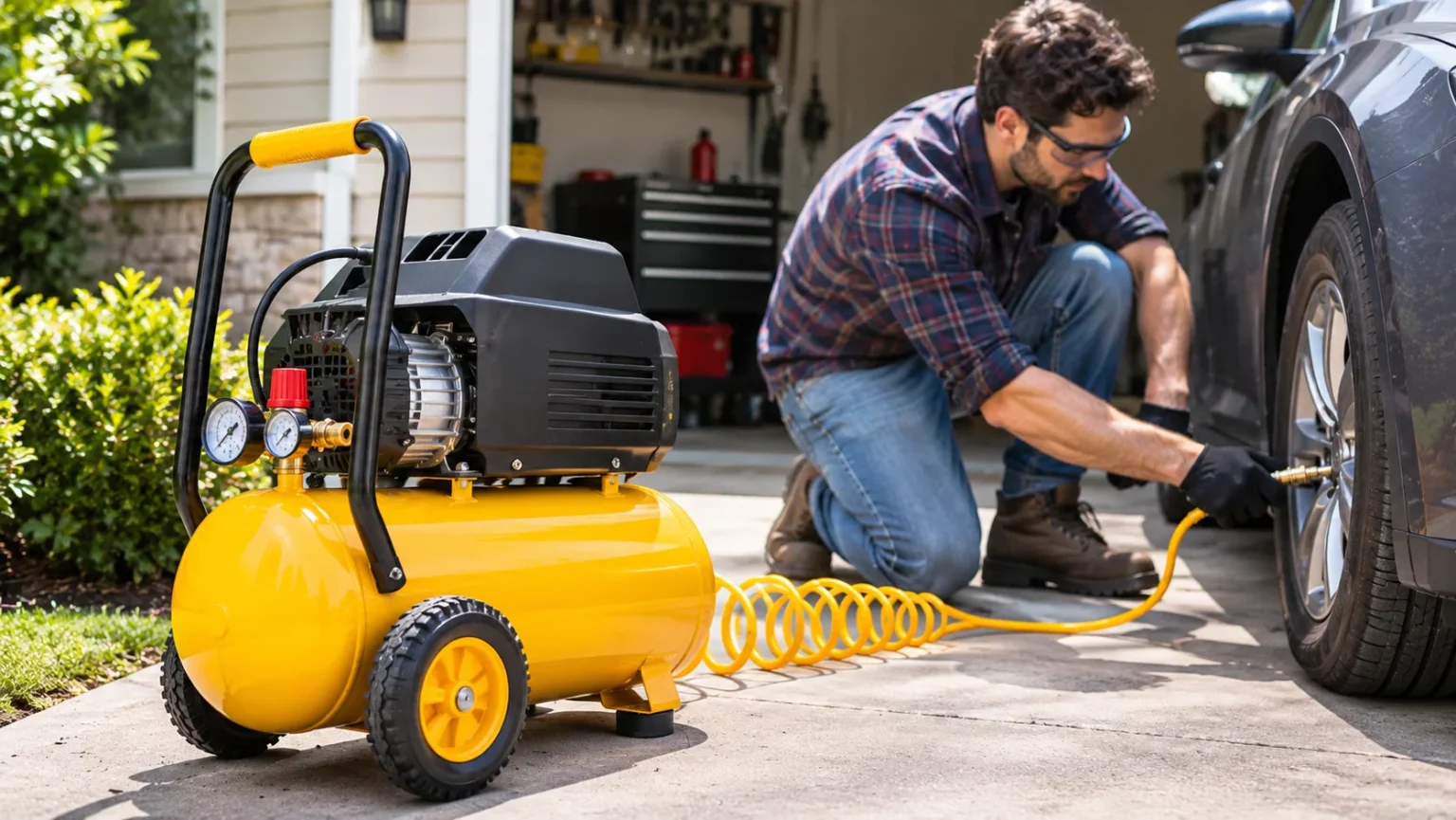
A portable air compressor is a useful tool for inflating tires, powering compatible pneumatic equipment, and handling everyday maintenance tasks. Whether you need one for your garage, workshop, vehicle, or occasional home projects, choosing the right model can improve convenience and efficiency. However, different compressors offer different pressure ratings, airflow capacities, power sources, and portability features.
Buying the wrong portable air compressor can lead to disappointing performance, unnecessary expenses, and compatibility problems. Some models are designed mainly for tire inflation, while others support a wider range of air-powered applications. This guide explains the important features, compressor types, specifications, costs, and common buying mistakes to help you make an informed purchasing decision.
What Is a Portable Air Compressor?
A portable air compressor is a device that compresses air and supplies it for various applications. Unlike large stationary compressors, portable models are designed for easier transportation and storage. They are commonly used for vehicle tire inflation, recreational equipment, light maintenance, and compatible pneumatic tools in home or professional environments.
Portable air compressors come in different sizes, ranging from compact handheld inflators to larger wheeled units. Smaller models often focus on inflation tasks, while larger compressors may include storage tanks and higher airflow capacity. The design, motor, and power source determine which activities a particular model can support effectively.
Understanding the difference between an inflator and a general-purpose compressor is important before purchasing. A compact tire inflator may provide sufficient pressure for vehicle tires but lack the airflow needed for pneumatic equipment. Choosing equipment based on intended applications helps prevent performance problems and unnecessary spending on features you may never use.
Types of Portable Air Compressors
Portable air compressors are available in several designs with different performance characteristics. Common categories include tankless inflators, pancake compressors, hot dog compressors, and twin-stack models. Each design offers a different combination of storage capacity, weight, portability, and suitability for specific applications or working environments.
Tankless inflators are compact devices primarily designed for inflating tires and other compatible items. Pancake compressors feature rounded air tanks that provide a stable base, while hot dog compressors use horizontal cylindrical tanks. Twin-stack designs use two connected tanks and may provide greater air storage than some similarly sized alternatives.
Selecting the right compressor type depends on how frequently it will be used and what equipment it needs to support. Compact inflators suit occasional vehicle-related tasks, while tank-based models offer additional versatility. Buyers should compare actual specifications rather than assuming that one compressor shape automatically provides better performance than another.
Important Features to Check Before Buying
Choosing a portable air compressor requires evaluating several technical features together. Maximum pressure, airflow capacity, tank size, power requirements, and duty cycle all influence overall performance. Understanding these specifications can help you identify a compressor that meets your needs without paying for unnecessary capacity or additional accessories.
Portability features also deserve attention because compact equipment is not always convenient to transport. Carrying handles, wheels, overall weight, and storage dimensions can influence everyday usability. A compressor intended for frequent movement may benefit from a lightweight design, while workshop applications may prioritize stability and performance.
Additional features can improve convenience and safety when they are appropriately designed. Automatic shutoff, pressure displays, thermal protection, and clearly labeled controls are examples worth considering. Look for products with reliable documentation, suitable electrical certifications, and manufacturer support instead of selecting equipment based entirely on promotional descriptions.
Understanding PSI in Portable Air Compressors
PSI stands for pounds per square inch and measures air pressure. Portable air compressors advertise maximum PSI ratings to indicate their pressure capabilities. This specification is particularly relevant for tire inflation and other applications that require specific operating pressures, although maximum PSI alone does not describe total compressor performance.
A higher maximum PSI does not automatically mean that a compressor is better for every application. Different tasks require different pressure ranges, and equipment must always be compatible with the intended pressure. Vehicle manufacturers and equipment providers generally specify the appropriate operating limits for their products.
Buyers should also consider the quality and readability of pressure gauges. Digital displays can make pressure readings easier to interpret, while analog gauges offer a familiar alternative. Regardless of the display type, accurate measurement and dependable pressure control are more important than choosing a compressor simply because it advertises a very high rating.
Understanding CFM and Airflow Capacity
CFM stands for cubic feet per minute and describes the volume of air a compressor supplies over a specific period. Airflow capacity is especially important when evaluating compressors for pneumatic equipment. Certain tools require continuous airflow, while others operate intermittently and may have different air supply demands.
Manufacturers often provide airflow ratings at particular operating pressures. For example, a compressor may have separate performance figures measured at 40 PSI and 90 PSI. Comparing ratings at the same pressure produces a more meaningful assessment than looking at the highest advertised CFM figure alone.
A compressor with insufficient airflow may struggle to support equipment that demands a continuous air supply. However, purchasing substantially more capacity than needed can increase cost, weight, and storage requirements. Reviewing the airflow requirements of compatible equipment helps buyers choose a balanced model without relying on pressure ratings alone.
Tank Size and Storage Capacity Explained
Some portable air compressors include tanks that store compressed air for later use. Tank capacity is commonly measured in gallons or liters and influences how much compressed air can be stored. A larger tank may reduce how frequently the motor needs to run during intermittent air demand.
However, tank size does not determine compressor performance by itself. Motor output, airflow delivery, pressure settings, and equipment requirements also influence how effectively the system operates. A large tank paired with a relatively low-output compressor may still be unsuitable for activities requiring sustained airflow.
Smaller tanks can be useful when portability and storage space are major priorities. Larger tanks may suit applications involving repeated short bursts of compressed air, depending on the compressor’s specifications. Evaluating tank capacity alongside airflow and duty cycle provides a more complete picture of the equipment’s capabilities.
Electric vs. Battery-Powered Air Compressors
Electric portable air compressors are commonly used in garages, workshops, and home maintenance environments. Corded models can provide a consistent power supply when compatible electrical outlets are available. Their performance varies widely, so buyers should examine motor specifications, electrical requirements, and intended applications before choosing a particular product.
Battery-powered compressors offer additional convenience when access to mains electricity is limited. Many compact cordless inflators are designed for portable tire inflation and recreational equipment. Their operating time depends on battery capacity, temperature, inflation demands, and the efficiency of the compressor.
Some portable models also use compatible vehicle power connections. These can be convenient for certain automotive applications but must match the vehicle’s electrical specifications. When comparing power sources, consider accessibility, runtime, battery compatibility, operating limitations, and overall cost rather than assuming cordless equipment is automatically more practical.
Oil-Free vs. Oil-Lubricated Compressors
Portable air compressors may use oil-free or oil-lubricated pump designs. Oil-free models are popular for many household applications because they generally require less routine pump maintenance. These compressors can be convenient for occasional users who prefer straightforward equipment ownership and relatively simple maintenance requirements.
Oil-lubricated compressors use lubrication systems intended to reduce friction within certain pump components. Some designs are suited to demanding applications, although maintenance requirements and operating characteristics vary by manufacturer. Oil-lubricated equipment may require periodic servicing that should be performed according to the product’s official instructions.
Neither design is universally better for every buyer. Oil-free compressors may offer convenience, while certain lubricated systems provide benefits for specific working conditions. Comparing expected usage, service intervals, noise ratings, and manufacturer support helps identify the design most appropriate for your intended environment.
Best Portable Air Compressor for Car Tires
Portable tire inflators are convenient for maintaining appropriate tire pressure and addressing minor inflation needs. Compact models are often small enough to store in a vehicle and may include digital pressure displays. Some products also feature automatic shutoff and different power connection options for added convenience.
When comparing tire inflators, consider compatibility with your vehicle’s tires and recommended inflation requirements. Larger tires may require different airflow performance and longer operating periods than smaller passenger vehicle tires. Manufacturer documentation should clearly explain supported tire sizes, pressure limitations, and any operating restrictions.
A tire inflator is not a substitute for professional tire inspection or repair. Damaged tires, unusual pressure loss, and visible sidewall problems require appropriate assessment. Buyers should prioritize reliable pressure measurement, suitable power connections, and clear safety instructions over unnecessary accessories or exaggerated inflation-speed claims.
Portable Air Compressors for Home and Garage Use
A portable air compressor can be useful for several household and garage applications when paired with compatible equipment. Some homeowners use compressors for inflation, cleaning-related equipment, or selected pneumatic tools. However, each application has different airflow and pressure requirements, so one compact compressor may not support every task.
For occasional garage needs, a small tank-based compressor may provide more versatility than a handheld inflator. Larger models can support a broader range of compatible equipment when their specifications meet the required demand. Storage space, noise, and available electrical power should also influence the purchasing decision.
Homeowners should choose products with clear operating instructions and appropriate protective features. Compressed air can cause injuries when equipment is misused, and pneumatic tools introduce additional hazards. Follow manufacturer safety guidance, avoid directing compressed air toward people, and leave unfamiliar or high-risk applications to trained adults or qualified professionals.
Noise Levels and Portability Considerations
Noise is an important consideration when choosing a compressor for residential environments. Some models produce substantial sound during operation, which may be disruptive in garages or shared spaces. Manufacturers sometimes advertise decibel ratings, allowing buyers to compare general noise performance between products.
However, noise ratings should be compared carefully because measurement methods and operating conditions can differ. A compressor advertised as quiet may still produce noticeable sound in an enclosed room. Equipment placement, surrounding surfaces, and the distance from nearby living areas can influence how loud the compressor seems.
Portability also involves more than the weight printed on the product label. Handles, wheel quality, overall dimensions, and storage convenience can make a difference during transportation. Choosing a compressor that fits comfortably within your available space helps avoid buying equipment that becomes inconvenient to store or move.
Common Portable Air Compressor Buying Mistakes
One common mistake is selecting a compressor based only on maximum PSI. Although pressure is important, many applications also require sufficient airflow and suitable operating capacity. Ignoring CFM ratings, duty cycle, and equipment compatibility can result in purchasing a compressor that cannot support the intended workload.
Another mistake is overlooking power requirements and portability. A compressor may offer impressive specifications but require an electrical connection unavailable in the intended location. Similarly, a heavy model without convenient carrying features may be impractical for frequent transportation or limited storage areas.
Buyers also sometimes focus entirely on the purchase price while ignoring quality and long-term support. Limited warranties, unavailable replacement parts, and unclear instructions can create additional expenses. Comparing durability, safety features, manufacturer reputation, and service availability can lead to a more reliable purchase decision.
How Much Does a Portable Air Compressor Cost?
Portable air compressor prices vary according to size, capacity, brand, and intended use. Basic compact inflators may cost approximately $25 to $100 in the United States. These models are generally designed for everyday inflation tasks rather than demanding pneumatic applications, although capabilities differ between individual products.
Small tank-based portable compressors commonly fall into a broader price category, with many household models costing approximately $100 to $300. Higher-output units, specialized quiet compressors, and premium professional equipment can cost considerably more. These ranges are general budgeting estimates rather than current verified retailer quotes.
The initial price is only one part of the total ownership expense. Accessories, compatible power supplies, batteries, maintenance materials, and replacement components may add to overall costs. Comparing complete product packages and warranty conditions can help buyers understand what they are paying for before selecting a particular compressor.
How to Compare Portable Air Compressor Brands
Different manufacturers offer compressors designed for household, automotive, and professional applications. Established brands may provide several product ranges with different performance levels and warranty arrangements. However, brand recognition alone does not guarantee that a specific model will meet your intended requirements.
Product specifications should remain the main comparison point. Evaluate airflow ratings, pressure limits, tank capacity, noise, power requirements, and included safety features. Reviews from verified owners may also provide useful information about reliability, convenience, and common limitations, although individual experiences can vary.
Manufacturer support deserves particular attention when buying equipment expected to last several years. Accessible product manuals, replacement parts, and clear warranty procedures can make long-term ownership easier. Selecting a model with appropriate specifications and dependable support is generally more useful than choosing the most advertised brand.
Safety Features to Look for Before Buying
Safety features are important because compressed air stores energy and must be managed carefully. Well-designed compressors may include pressure relief devices, thermal overload protection, automatic shutoff, and clearly marked pressure limits. These components help support safe equipment operation when used according to the manufacturer’s instructions.
Electrical safety is another important purchasing consideration. Corded compressors should have compatible electrical ratings and appropriate certification for their intended market. Battery-powered products should use manufacturer-approved batteries and charging systems, while damaged cords or components should be addressed by qualified service personnel.
Buyers should also consider whether the product includes readable instructions and appropriate safety warnings. Protective features cannot eliminate every risk associated with compressed air or pneumatic equipment. Selecting a reputable product and following official guidance helps reduce preventable hazards, particularly in environments where inexperienced users may be present.
Maintenance and Long-Term Reliability
Regular maintenance helps portable air compressors remain dependable over time. Maintenance requirements vary according to pump design, tank construction, and operating conditions. Manufacturers typically provide service schedules and inspection guidance that explain which tasks should be performed by owners and which require qualified technicians.
Moisture management is particularly important for compressors with storage tanks. Condensation can develop inside compressed-air systems and may contribute to corrosion or other problems when not properly managed. Buyers should look for clear manufacturer guidance and accessible professional servicing options rather than attempting unfamiliar maintenance procedures.
Long-term reliability also depends on storage conditions and equipment quality. Excessive moisture, physical damage, and unsuitable temperatures can affect certain compressor components. Keeping the equipment in an appropriate storage environment and arranging professional inspections when problems appear can support dependable performance throughout its service life.
How to Choose the Right Portable Air Compressor
Start by identifying the main activities for which the compressor will be needed. Tire inflation, occasional household tasks, and professional pneumatic equipment can require very different performance characteristics. Understanding the intended applications helps narrow the available options before comparing technical specifications and product features.
Next, review maximum pressure, airflow capacity, power requirements, and any tank or duty-cycle limitations. Consider the available storage space and whether the compressor will frequently move between locations. Safety features, noise levels, warranty coverage, and service support should also influence the final decision.
Finally, compare several products within a realistic budget rather than choosing the first inexpensive model. A well-matched compressor should provide appropriate performance without unnecessary size, complexity, or expense. Taking time to evaluate complete specifications can help buyers select equipment that remains practical for their intended needs.
Conclusion
Choosing the right portable air compressor begins with understanding its purpose and technical capabilities. Maximum PSI, CFM, tank size, power source, and portability all influence equipment suitability. Comparing these features helps prevent common purchasing mistakes and ensures that the selected model is designed for the applications you expect.
Compact tire inflators may be suitable for occasional vehicle maintenance, while tank-based compressors provide additional possibilities for compatible equipment. However, larger or more expensive models are not automatically better for every user. Safety features, manufacturer instructions, service availability, and realistic operating requirements should remain important considerations.
Before making a purchase, review product specifications, compare warranty conditions, and account for accessories or maintenance expenses. Choose equipment from a dependable manufacturer that provides clear documentation and suitable support. With thoughtful research, you can select a portable air compressor that delivers practical value, convenience, and reliable performance.
Frequently Asked Questions
What Is the Best Portable Air Compressor for Home Use?
The best model depends on your intended tasks. Compact inflators suit basic inflation needs, while small tank-based compressors may support more applications when their pressure and airflow ratings match compatible equipment.
How Much PSI Does a Portable Air Compressor Need?
The required PSI depends on the equipment being used. Vehicle tires and pneumatic tools have different pressure requirements, so check the relevant manufacturer’s specifications before selecting a compressor.
What Is the Difference Between PSI and CFM?
PSI measures air pressure, while CFM measures airflow volume over time. Both specifications matter because a compressor must provide suitable pressure and sufficient airflow for its intended application.
Are Oil-Free Portable Air Compressors Better?
Oil-free compressors often require less routine pump maintenance and can be convenient for household use. However, the better choice depends on workload, durability requirements, noise preferences, and manufacturer recommendations.
How Long Does a Portable Air Compressor Last?
Service life varies according to product quality, usage frequency, maintenance, and operating conditions. Following manufacturer guidance, arranging appropriate servicing, and storing equipment properly can help support long-term reliability.